Department of Computer Engineering
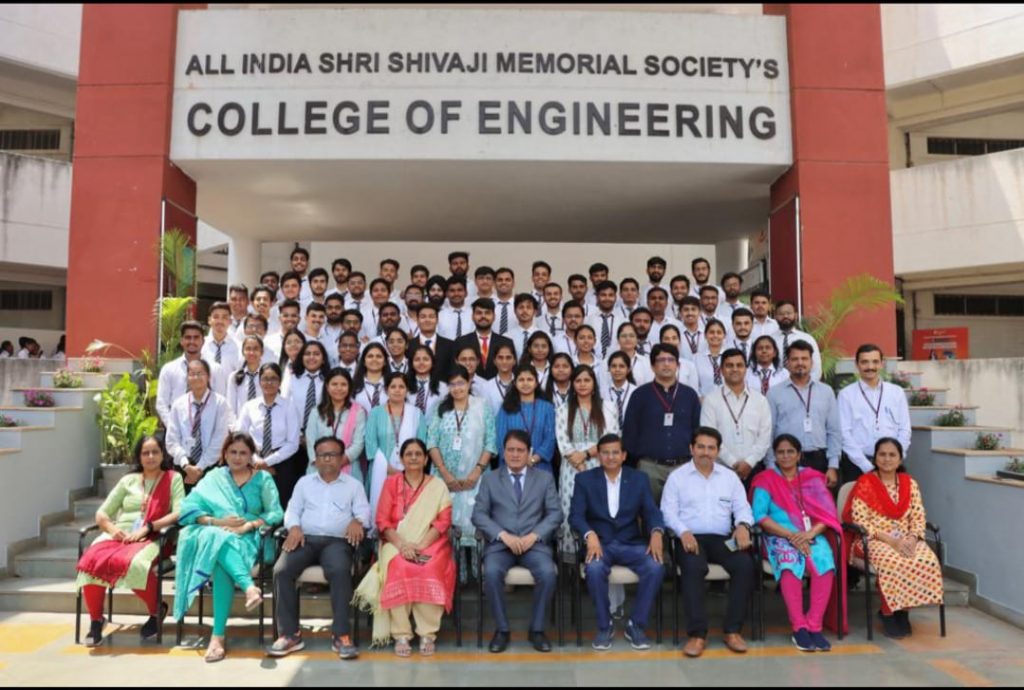
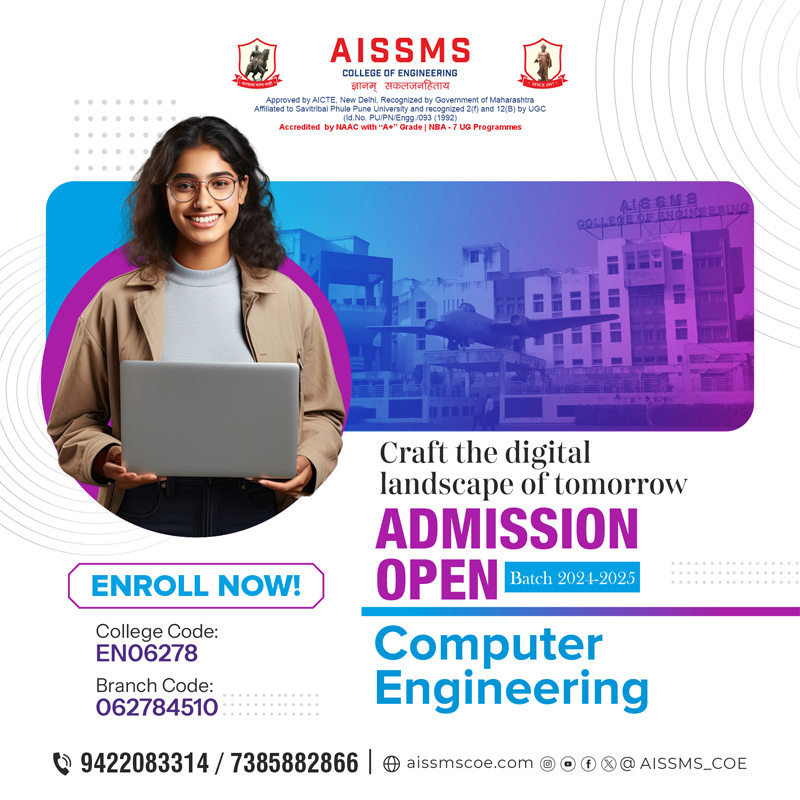

One of the Best Computer Engineering College in Pune, India – AISSMS College Of Engineering was started in the year 1998. The goal of the Department is to prepare students for successful careers in software and hardware industry that meets the needs of Indian and multinational companies and to excel in higher studies. The Department has experienced and dedicated faculty members with strong commitment to the engineering education and professional ethics.
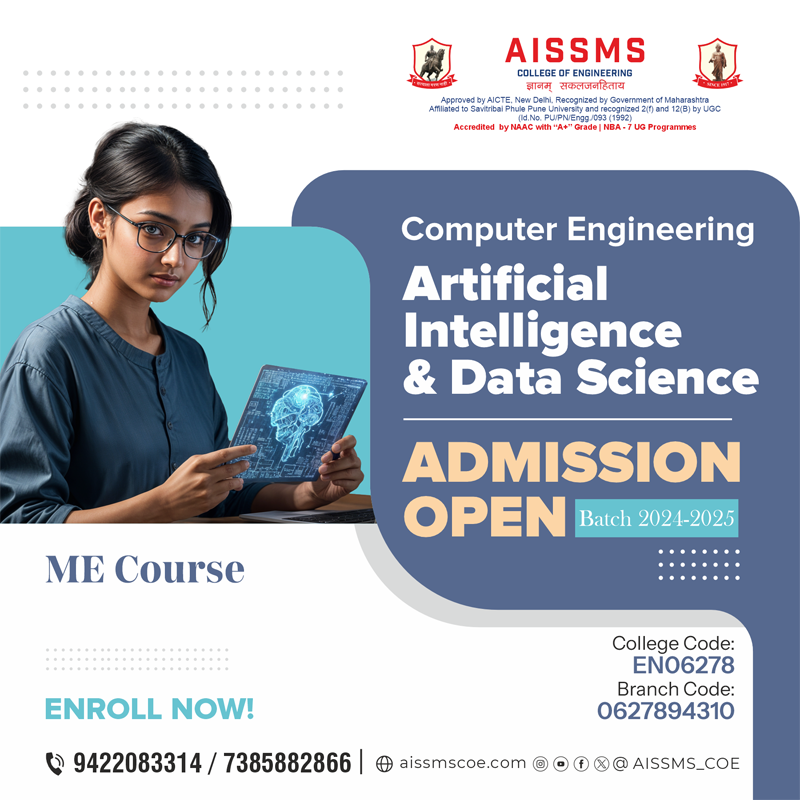
Ranking and Achievement AISSMS College of Engineering have started newly Master degree (PG) course (ME) in Artificial Intelligence and Data Science in Department of Computer Engineering from Academic Year 2021-22
Recently from the academic year 2021-22, PhD Research center for the Computer engineering has been started.
Intake of Computer Engineering Department:
| Undergraduate & Postgraduate | Annual Intake | |
|---|---|---|
|
UG |
PG in Artificial Intelligence and Data Science |
|
| Computer Engineering Div A |
60 |
18 |
| Computer Engineering Div B |
60 |
|
| Ph.D. Computer Engineering |
|
|
Ph.D. RESEARCH CENTER
Department of Computer Engineering is approved research centre in Computer Engineering by Savitribai Phule Pune University since August 2021.
Vision:
- Contributing to the welfare of society through technical and quality education.
Mission:
- M1: To cultivate technologically proficient and self-reliant professionals through a dynamic, industry-relevant curriculum.
- M2: To inspire innovative thinking and foster collaborative research that drives meaningful contributions to society.
- M3: To offer a cutting-edge computing environment and diverse learning opportunities through our Centre of Excellence.
- M4: To develop leadership capabilities and ethical values, promoting holistic growth and personal development.
Short Term Goals:
- To enhance placement activities in the department.
- To increase the participation of students in co-curricular and extra-curricular activities.
- To motivate students to develop social significant projects.
- To strengthen Industry Institute Interaction.
- To enhance research oriented activities in the department.
Long Term Goals:
- To motivate students to enroll for internship in industry.
- To have more doctorates in the department.
- To setup the centre of excellence in collaboration with renowned industries.
- To setup the research centre in the department.
- To initiate job related certification courses.
Programme Outcomes (PO):
PO1. Engineering knowledge: Apply the knowledge of mathematics, science, engineering fundamentals, and an engineering specialization to the solution of complex engineering problems.
PO2. Problem analysis: Identify, formulate, research literature, and analyze complex engineering problems reaching substantiated conclusions using first principles of mathematics, natural sciences, and engineering sciences.
PO3. Design/development of solutions: Design solutions for complex engineering problems and design system components or processes that meet the specified needs with appropriate consideration for the public health and safety, and the cultural, societal, and environmental considerations.
PO4. Conduct investigations of complex problems: Use research-based knowledge and research methods including design of experiments, analysis and interpretation of data, and synthesis of the information to provide valid conclusions.
PO5. Modern tool usage: Create, select, and apply appropriate techniques, resources, and modern engineering and IT tools including prediction and modeling to complex engineering activities with an understanding of the limitations.
PO6. The engineer and society: Apply reasoning informed by the contextual knowledge to assess societal, health, safety, legal and cultural issues and the consequent responsibilities relevant to the professional engineering practice.
PO7. Environment and sustainability: Understand the impact of the professional engineering solutions in societal and environmental contexts, and demonstrate the knowledge of, and need for sustainable development.
PO8. Ethics: Apply ethical principles and commit to professional ethics and responsibilities and norms of the engineering practice.
PO9. Individual and teamwork Function effectively as an individual, and as a member or leader in diverse teams, and in multidisciplinary settings.
PO10. Communication: Communicate effectively on complex engineering activities with the engineering community and with society at large, such as, being able to comprehend and write effective reports and design documentation, make effective presentations, and give and receive clear instructions.
PO11. Project management and finance: Demonstrate knowledge and understanding of the engineering and management principles and apply these to one’s own work, as a member and leader in a team, to manage projects and in multidisciplinary environments.
PO12. Life-long learning: Recognize the need for, and have the preparation and ability to engage in independent and life-long learning in the broadest context of technological change.
Programme Specific Outcomes (PSO):
PSO 1. Technical Proficiency and Domain Expertise
Graduates will be able to apply comprehensive knowledge of computer science to analyse, design, and develop efficient computer-based systems and solutions in diverse domains such as algorithms, system software, web technologies, data science, artificial intelligence, computer networks, and cybersecurity.
PSO 2. Analytical and Problem-Solving Competence
Graduates will be able to identify, analyse, and formulate solutions to real-world problems using modern computing tools, technologies, and software engineering principles to build reliable, scalable, and efficient software systems.
PSO 3. Professional Growth and Lifelong Learning
Graduates will be able to exhibit professional excellence, leadership qualities, and an entrepreneurial mindset, with a commitment to continuous learning and adaptability in multidisciplinary, research, and industrial environments.
Program Educational Objectives (PEO):
PEO1: Graduates will demonstrate strong analytical and problem-solving skills to excel in diverse roles across the IT industry.
PEO2: Graduates will apply theoretical and technical knowledge to design and implement effective, data-driven solutions for real-world problems.
PEO3: Graduates will pursue higher education, research, and professional development to achieve excellence in their chosen careers.
PEO4: Graduates will uphold ethical values, professional integrity, and social responsibility while contributing to sustainable societal growth.