Department Of Electrical Engineering
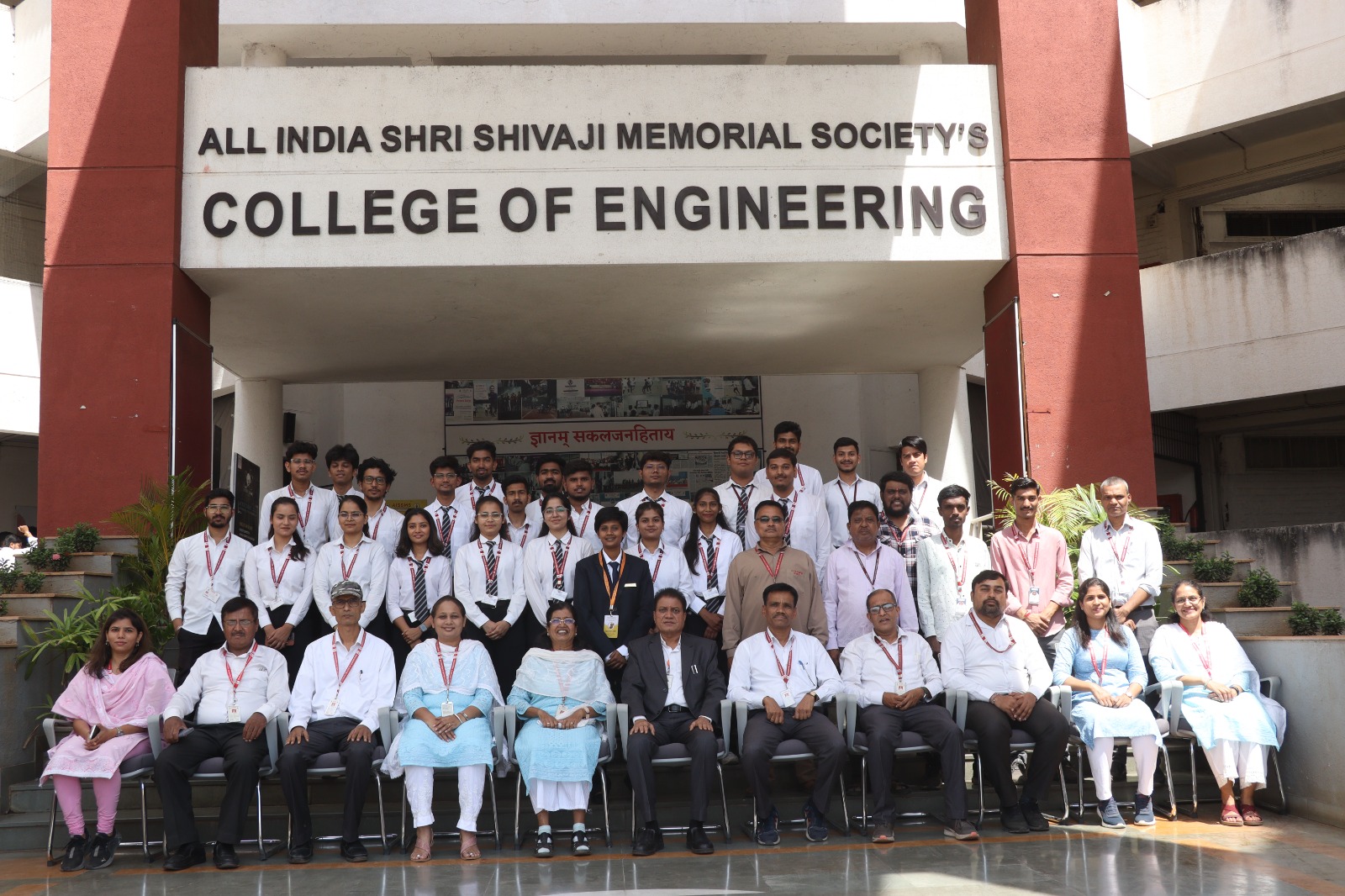
Since its inception in 1992, One of the Best Electrical Engineering College in Pune, India – AISSMS College Of Engineering has registered tremendous growth in teaching and research. The Department offers a regular four-year B.E program in “Electrical Engineering” and Post Graduate program M.E. in “Power Electronics and Drives” under affiliation of Savitribai Phule Pune University.
Intake of Electrical Engineering Department:
| Programme | Year of Establishment | Sanction Intake |
|---|---|---|
| UG – Electrical Engineering | 1992 | 60 |
| PG – Power Electronics and Drives | 2011 | 18 |
Vision:
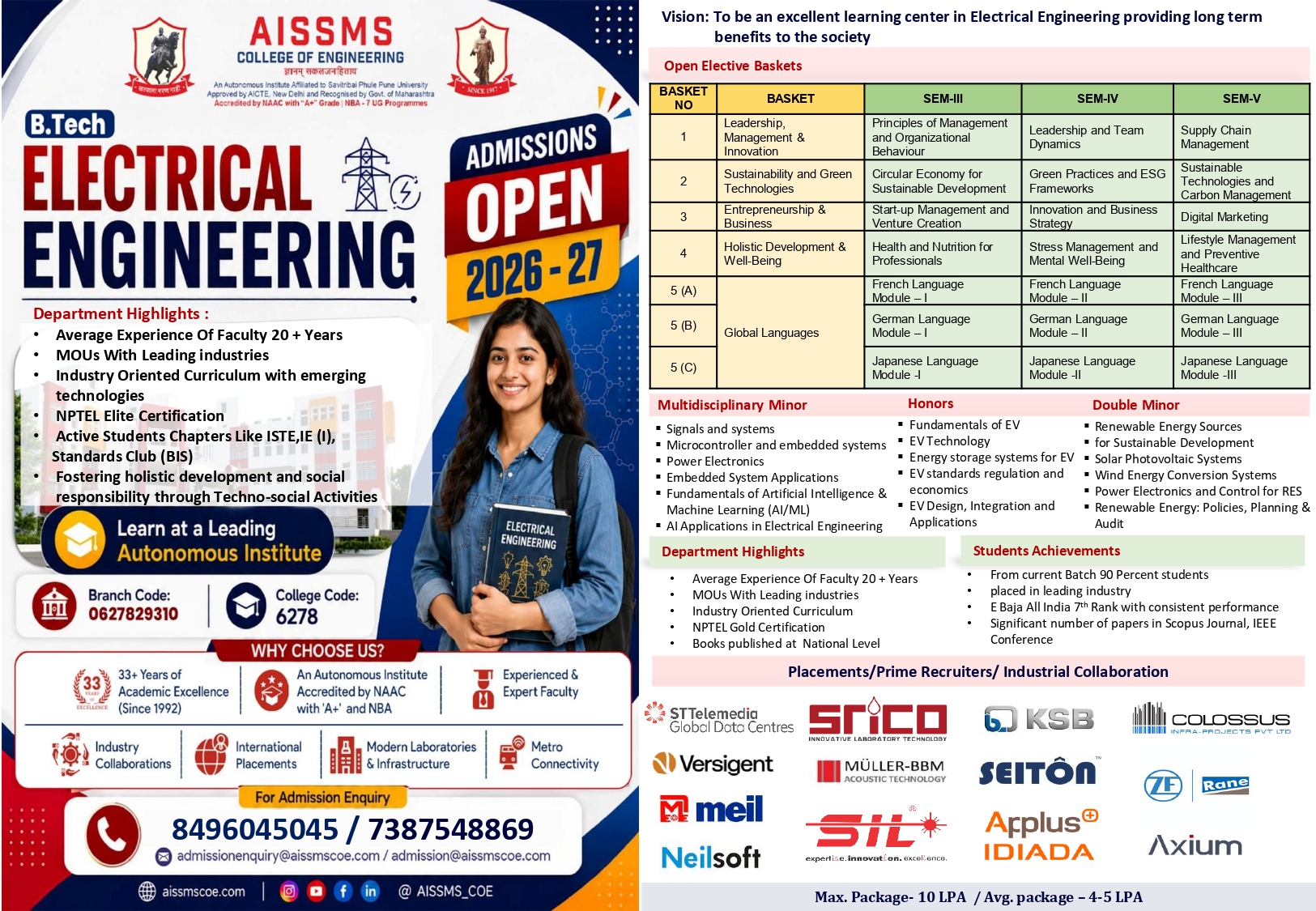
- To be an excellent learning center in Electrical Engineering providing long term benefits to the society
Mission:
- To impart knowledge in the field of Electrical Engineering using contemporary learning tools
- To promote research culture among students and faculty
- To serve society with deep awareness of social responsibility and ethics
- To collaborate with industry for value addition in academics
Short-term Goals:
- To encourage faculty for upgradation of qualification
- To promote extensive use of ICT and advanced pedagogical methodologies for enhanced learning experience
- To increase activities that encourage lifelong learning and sustainability
- To improve industry- academia collaboration
Long-term Goals:
- To nurture an environment conducive for entrepreneurship development
- To receive funds/grants from central funding agencies
- Initiation of Research and Consultancy by involving Industry/Defense sector
Program Outcomes (POs):
Engineering Graduates will be able to :
PO 1: Engineering Knowledge: Apply knowledge of mathematics, natural science, computing, engineering fundamentals and an engineering specialization as specified in WK1 to WK4 respectively to develop to the solution of complex engineering problems.
PO 2: Problem Analysis: Identify, formulate, review research literature and analyze complex engineering problems reaching substantiated conclusions with consideration for sustainable development. (WK1 to WK4)
PO 3: Design / Development of Solutions: Design creative solutions for complex engineering problems and design / develop systems / components / processes to meet identified needs with consideration for the public health and safety, whole-life cost, net zero carbon, culture, society and environment as required. (WK5)
PO 4: Conduct Investigations of Complex Problems: Conduct investigations of complex engineering problems using research-based knowledge including design of experiments, modeling, analysis & interpretation of data to provide valid conclusions. (WK8).
PO 5: Engineering Tool Usage: Create, select and apply appropriate techniques, resources and modern engineering & IT tools, including prediction and modeling recognizing their limitations to solve complex engineering problems. (WK2 and WK6)
PO 6: The Engineer and The World: Analyze and evaluate societal and environmental aspects while solving complex engineering problems for its impact on sustainability with reference to economy, health, safety, legal framework, culture and environment. (WK1, WK5, and WK7).
PO 7: Ethics: Apply ethical principles and commit to professional ethics, human values, diversity and inclusion; adhere to national & international laws. (WK9)
PO 8: Individual and Collaborative Team work: Function effectively as an individual, and as a member or leader in diverse/multi-disciplinary teams.
PO 9: Communication: Communicate effectively and inclusively within the engineering community and society at large, such as being able to comprehend and write effective reports and design documentation, make effective presentations considering cultural, language, and learning differences
PO 10: Project Management and Finance: Apply knowledge and understanding of engineering management principles and economic decision-making and apply these to one’s own work, as a member and leader in a team, and to manage projects and in multidisciplinary environments.
PO 11: Life-Long Learning: Recognize the need for, and have the preparation and ability for i) independent and life-long learning ii) adaptability to new and emerging technologies and iii) critical thinking in the broadest context of technological change. (WK8)
Program Specific Objectives(PSOs):
- PSO1: Demonstrate comprehensive knowledge and technical competence in analyzing and solving
problems related to Power and Energy Systems, Control and Drives - PSO2: Obtain industrial exposure through internship and hands-on training, enabling them to apply theoretical knowledge to real-world engineering practices and adapt to modern technologies.
- PSO3: Exhibit their abilities of soft skills and self-learning skills through teamwork, while emphasizing professional ethics