In today’s rapidly evolving digital world, engineering education must go far beyond textbooks and traditional classrooms. The future belongs to engineers who can think critically, build real-world solutions, and continuously adapt to emerging technologies. Recognizing this need, forward-looking departments are redefining education through unique academic practices, state-of-the-art laboratories, and Centers of Excellence that bridge the gap between academic learning and industry expectations.
At the heart of this transformation lies a simple philosophy: learning should not just inform students; it should empower them to innovate, experiment, and excel globally.
Unique Academic Practices: Learning Beyond the Classroom
One of the most defining academic initiatives is the establishment of the computer department’s technical club, CIPHERS. More than just a student club, CIPHERS serves as a collaborative academic platform designed to foster peer learning, resource sharing, and technical excellence.
The CIPHERS website has become a powerful digital academic resource. It hosts a comprehensive collection of laboratory manuals, practical programs, implementation guides, and academic resources aligned with the university syllabus. This initiative ensures that students have uninterrupted access to essential learning materials anytime and anywhere. Instead of depending solely on printed manuals or classroom hours, students can independently review concepts, practice programming exercises, and strengthen their understanding. This approach has significantly improved student engagement and confidence. Students can prepare before laboratory sessions, revise after practicals, and explore advanced variations of experiments. It also promotes self-paced learning as an essential skill in the technology sector, where engineers must continuously learn new tools and frameworks throughout their careers.
Website: https://ciphers.onrender.com/resources?type=programming
Modern Laboratories and Center of Excellence: Bridging Academic Learning with Industry Standards
To complement innovative academic practices, the computer department has established Modern laboratories and a fully equipped Center of Excellence on 11th of December 2025 within the academic building. These facilities provide students with hands-on exposure to advanced technologies and create an environment that closely resembles real-world industry settings. The laboratories are equipped with the latest generation of computers, high-performance systems, and modern software tools required for programming, networking, cloud computing, simulation, and research activities. Students use these labs to perform practical experiments, develop applications, test algorithms, and implement technical concepts learned in classrooms. The availability of such advanced infrastructure ensures that students gain practical experience alongside theoretical
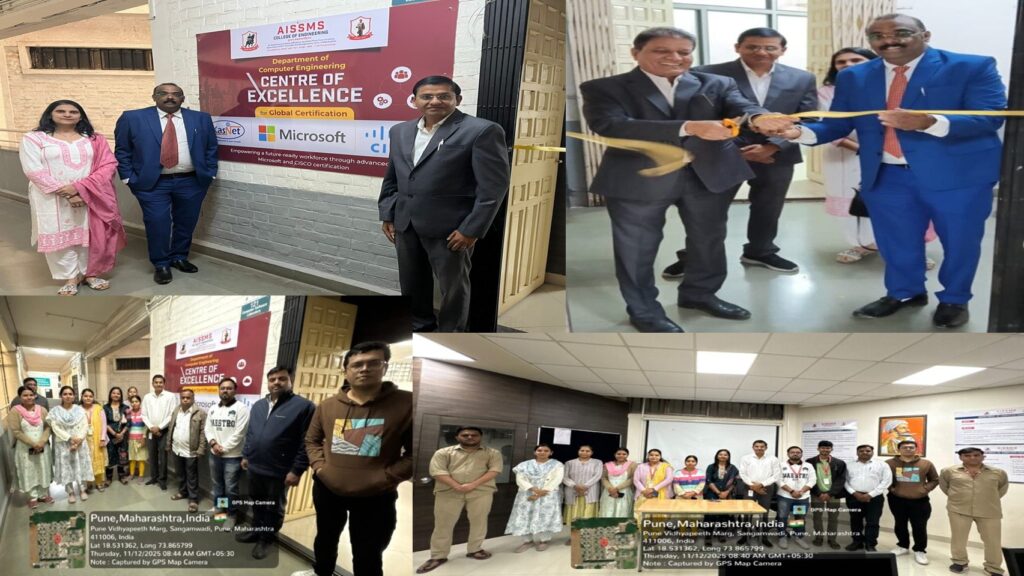
Inauguration of Center of Excellence AISSMS COE Pune.
The Center of Excellence further strengthens this learning ecosystem by providing a specialized environment focused on innovation, professional certification, and research. It enables students to work on advanced computing platforms, perform research-oriented projects, and explore emerging technologies. The infrastructure supports global certification programs such as Microsoft Azure and Cisco networking certifications, allowing students to gain internationally recognized credentials. Through the Center of Excellence, students also participate in Cisco internship programs, cloud computing practices, and real-world project development. This exposure prepares them to understand industry workflows, deployment processes, and modern computing architectures.
Competitive programming practice is another key activity conducted within the Center of Excellence. Students regularly solve algorithmic problems, participate in coding competitions, and improve their logical thinking and problem-solving abilities. These skills are essential for careers in software engineering, data science, and advanced computing domains. The facility also supports virtual labs, enabling students to simulate systems, deploy configurations, and perform experiments in controlled digital environments. This flexibility enhances learning efficiency and allows students to explore technologies without hardware limitations.
Together, modern laboratories and the Center of Excellence serve as the backbone of practical education. They provide students with opportunities to experiment, innovate, and gain confidence in working with real-world technologies. These facilities ensure that students graduate with both academic knowledge and professional competence.
Building Industry-Ready Professionals Through Practical Exposure
The integration of unique academic practices, advanced laboratories, and Centers of Excellence creates a powerful ecosystem that prepares students for real-world challenges. Students are no longer limited to theoretical knowledge. Instead, they gain practical exposure, hands-on experience, and industry-relevant skills. They learn how to design systems, troubleshoot problems, optimize performance, and implement scalable solutions. This holistic academic environment helps students develop essential professional competencies such as analytical thinking, technical problem-solving, independent learning, team collaboration, and innovation and creativity. Such skills are critical not only for securing employment but also for contributing meaningfully to technological advancement.
Future Vision: Advancing Towards Next-Generation Technologies
The journey toward academic excellence is continuous. Looking ahead, there are several exciting plans to further enhance infrastructure and learning opportunities. Future developments include expanding the Center of Excellence to support emerging technologies such as Artificial Intelligence, Machine Learning, Cybersecurity, Internet of Things (IoT), and Cloud-Native Development.
The department also aims to strengthen industry collaborations, enabling students to work on live industry projects, internships, and research initiatives. Integration of global certification programs will continue to expand, ensuring students remain aligned with evolving technology standards. Upgrades in computing infrastructure, high-performance systems, and advanced simulation tools will further enhance research capabilities and innovation potential. The CIPHERS platform will continue to evolve as a comprehensive digital knowledge hub, integrating video tutorials, project repositories, coding challenges, and collaborative learning modules. These initiatives will ensure that students remain future-ready and globally competitive.
Conclusion: Empowering Engineers for a Technology-Driven Future
Engineering education is undergoing a powerful transformation. Unique academic practices like the CIPHERS platform, modern laboratories designed for hands-on learning, and the establishment of a Center of Excellence are redefining how students learn, innovate, and grow. By combining academic excellence with industry relevance, these initiatives create an ecosystem where students are empowered to explore, experiment, and excel. The result is not just graduates with degrees, but confident, skilled, and future-ready engineers capable of contributing to global technological progress. Through continuous innovation, infrastructure enhancement, and commitment to excellence, the department is shaping engineers who will lead, innovate, and transform the future.